This is the extended version of my keynote at SiGMA Euro-Med 2025 in Malta.
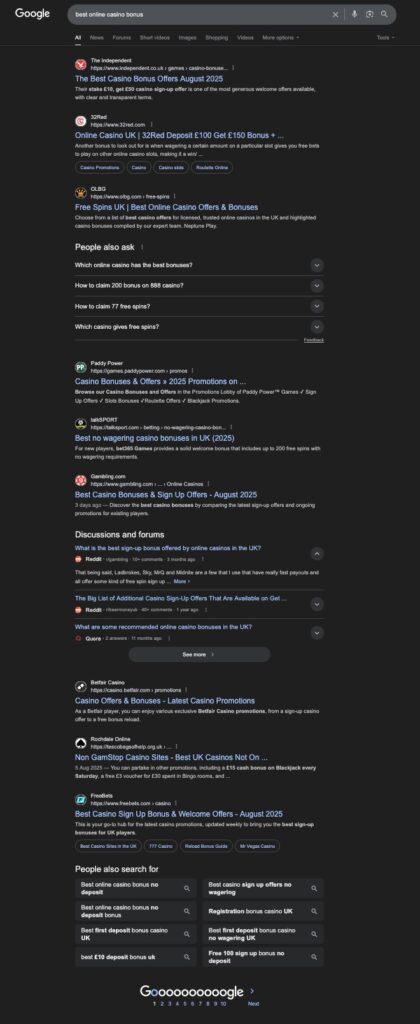
The best place to see what works and what doesn’t in a certain search vertical is of course the SERPs – but since the SERPs change a lot (especially casino SERPs), for you to still be on the same page as me whenever you’re reading this, I’m going to post a screenshot of the SERP we are going to discuss: UK SERPs for “best online casino bonus” in Google UK (for those of you who wants to see the current SERPs, here you go)
Anatomy of the SERPs
Apart from the 10 organic results, modern SERPs have a number of other elements which, on one hand, distract searchers from the sites ranking here, but on the other hand, provide extra opportunities:
1. People Also Ask – with their very visible position in the SERPs, this is your extra opportunity to obtain visibility even in the SERPs where you don’t rank organically if you manage to become the answer source for one or more of these questions;
2. Discussions and forums – there are several ways a site can benefit from these without ranking organically, either your casino brand is mentioned in the snippet displayed in the SERP and that prompts the searchers to search for your brand or just go to your site directly, or the searcher clicks through to Reddit or Quora, reads the discussion and either finds a link to their interest subject or a mention of a relevant brand. That, in turn, could again prompt either a new search for the mentioned brand, or direct traffic to the site if it is already familiar to the user. Traffic like that is extremely difficult to track and attribute, but that doesn’t mean it does not exist;
3. Search suggestions (People also search for) – this is your second chance for organic visibility even if you don’t rank in the initial SERPs. If the searcher initially does not find what they are looking for, they can modify their original query, and if the second query leads to the SERP where you are ranking, consider yourself lucky. And before you ask, yes, manipulating the search suggestions has been possible since search suggestions became a thing in the search engines. That’s why you sometimes see obviously odd looking suggestions leading to the SERPs where someone who could not rank for the big query actually appears.
It’s a long story
However, to really understand the dynamics of what’s working and what’s not, SERPs from one given moment are not enough – you want to have some context and see where all the sites you are currently seeing have been earlier and where they will end up later on. For later on, I can only advise to regularly look at the SERPs you’re interested in – there is no tool showing you the future (hence, anyone who claims to guarantee your site specific ranking is most likely just trying to sell you something). For the past though, things are easier – there are tools collecting snapshots of SERPs regularly, e.g. SISTRIX or SERanking:
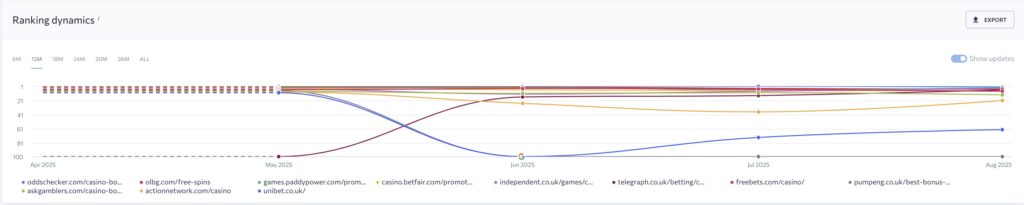
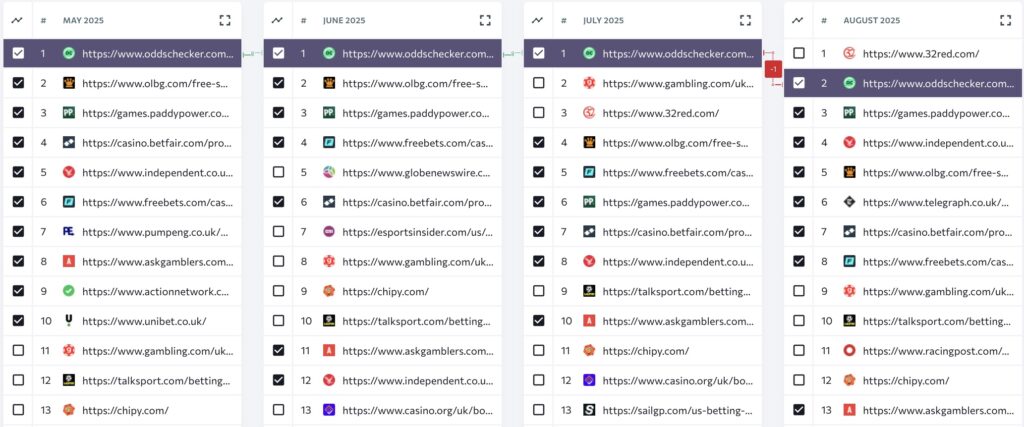
As we can see, out of the sites in the top 10 in May, by June only 5 still stayed in the top – later, most (but not all!) of the ones dropped from the top 10 have returned at some point or another, but not necessarily to their original positions, and 32red.com has appeared out of nowhere and straight into position 3, only to move further up to #1 in August. Now, on June 30 a Google core update started, with some changes in the SERPs reported even before the official announcement – so the drop of some sites could be attributed to that, along with whatever the dropped sites possibly did wrong and/or whatever the newly appearing sites did right. After every core update certain priorities in the algorithm change, and we need to remember that SERPs are a complex system – they reflect not just what each site does right or wrong, but rather a sum of all these actions as well as some sites’ lack of activity. If you do nothing at all, and your competitors are actively working on improving their rankings and organic visibility, you can’t stay ranking forever. Organic traffic cannot be gained once and then your site rests on its laurels – no matter how good you are at any given point, consistent actions are most important.
The core update finished by mid-July, but that does not mean the SERPs stop changing – infact, we are looking at a monthly snapshot, but the actual SERPs may be changing every day or even multiple times per day. Also, as of August 26, Google has announced a new spam update, and it remains to be seen which of the currently ranking sites will preserve their rankings and which ones will lose them.
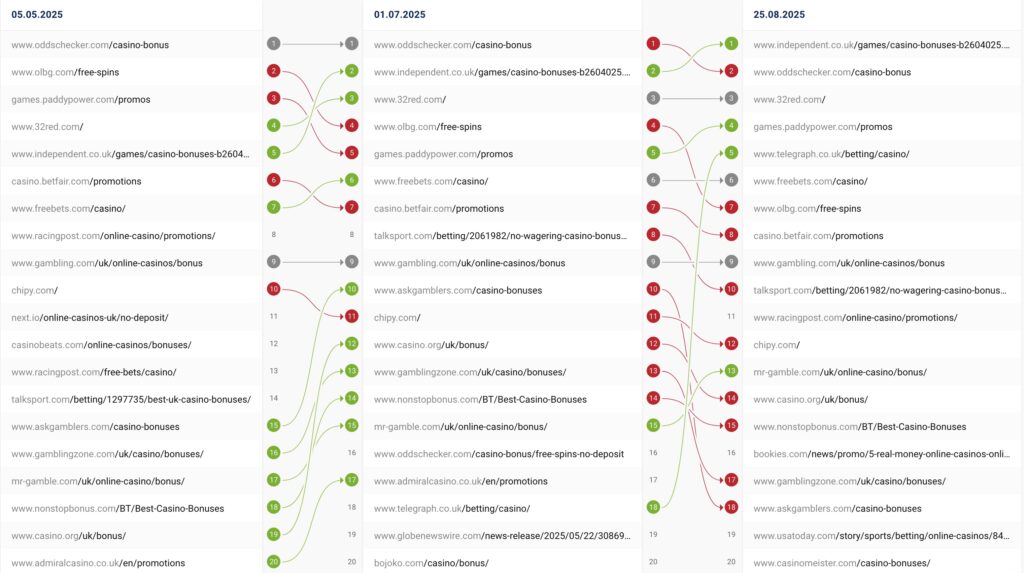
To further illustrate the intensity of changes in the SERPs, here is a snapshot of our “best online casino bonus” SERPs from a different tool, SISTRIX, on three specific dates: beginning of May, next day after the start of the June core update and the day before the start of the spam update. Red numbers and arrows reflect drops, green numbers and arrows reflect improvements, and grey ones mean no change:
So why do sites rank where they rank? One of the obvious answers would be links, but let’s look at some common misconceptions about links.
Links: the more the better?
Actually, no. Here is the comparison of number of links and linking domains of the sites that ranked in the top 10 of the SERPs we are discussing at some point in August:
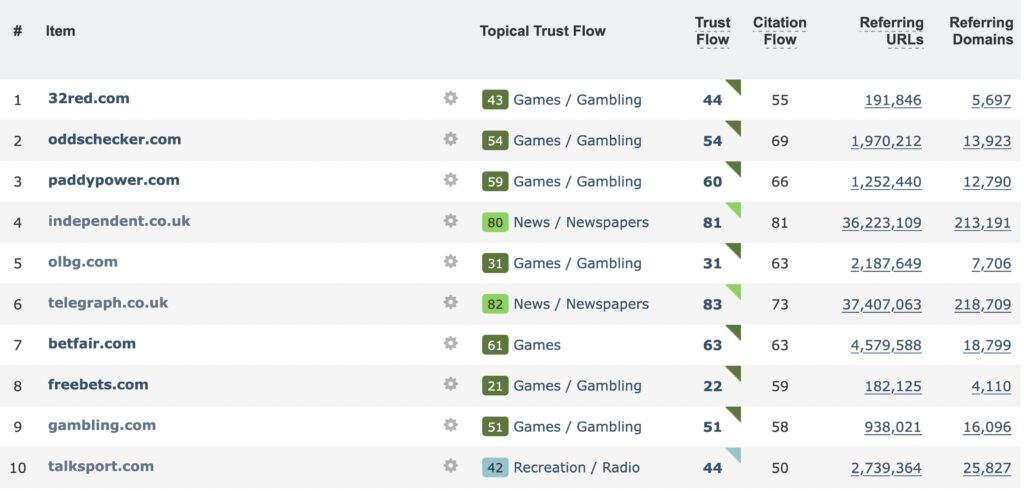
Let’s agree we only compare like to like and disregard the newspaper sites, and maybe even disregard TalkSport which, even though an affiliate, is not a typical affiliate and sits closer to the newspaper sites than to affiliate publishers. Let’s even disregard for now the fact that half the sites in this SERP are operators and not affiliates – we’ll get back to it later.
The top ranking site and the site with the most referring domains are two entirely different sites:
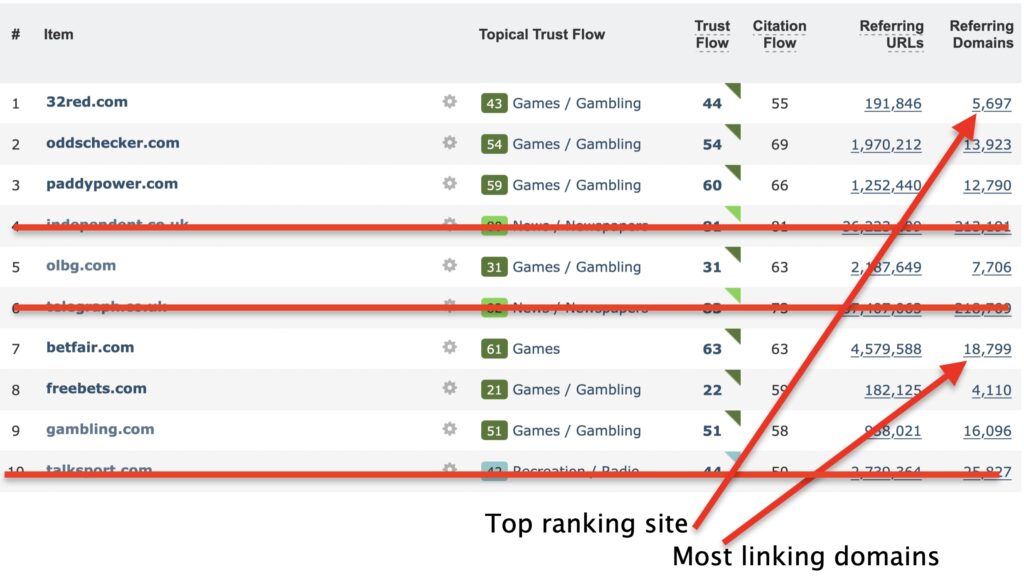
If we look further at the above screenshot, we will see that TrustFlow does not correlate very well with rankings either. Neither do DA, DR or any other third party metrics. In fact, Google’s John Mueller said explicitly a number of times that Google does not use any third party metrics as a ranking signal. Regardless of how widespread the third party SEO metrics manipulation services, they can only make a difference for you if you’re selling links or domains to clueless SEOs who still believe these make a difference.
Topical relevance of the link profile, on the other hand, does appear to be useful in this case – all the operator and affiliate sites in the screenshot above have relevant link profiles (see Topical TrustFlow). Even when you see sites with links from not very topically relevant sources ranking, having a topically relevant link profile still helps solidify the perception of the topical relevance of your site.
What about “malicious” links?
One of the most widely spread kinds of unwanted links sites get recently looks like this:
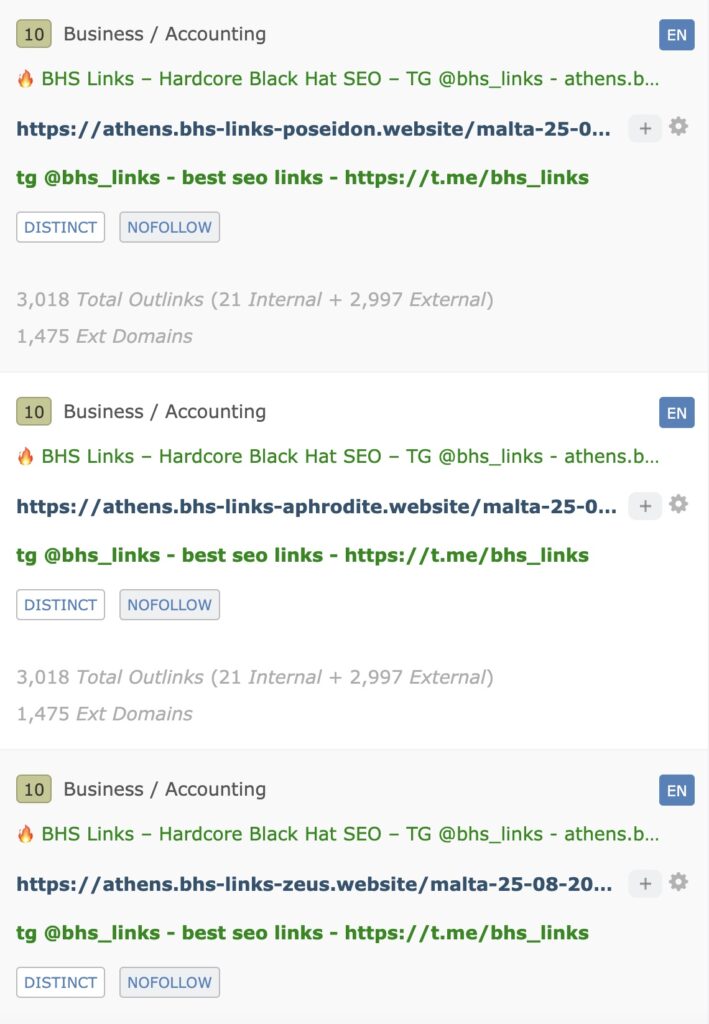
People would normally start asking, is somebody doing negative SEO against me? No, this is not negative SEO – this is somebody’s very weird idea of “direct marketing”. Those who do this do not care about your site losing rankings, or even about their sites getting indexed and ranking as a result of this link spam. All they are trying to achieve is to get the site owners to visit their sites and buy their “services”.
Can these links hurt you? Should you disavow them? Well, it depends on how strong your link profile is.
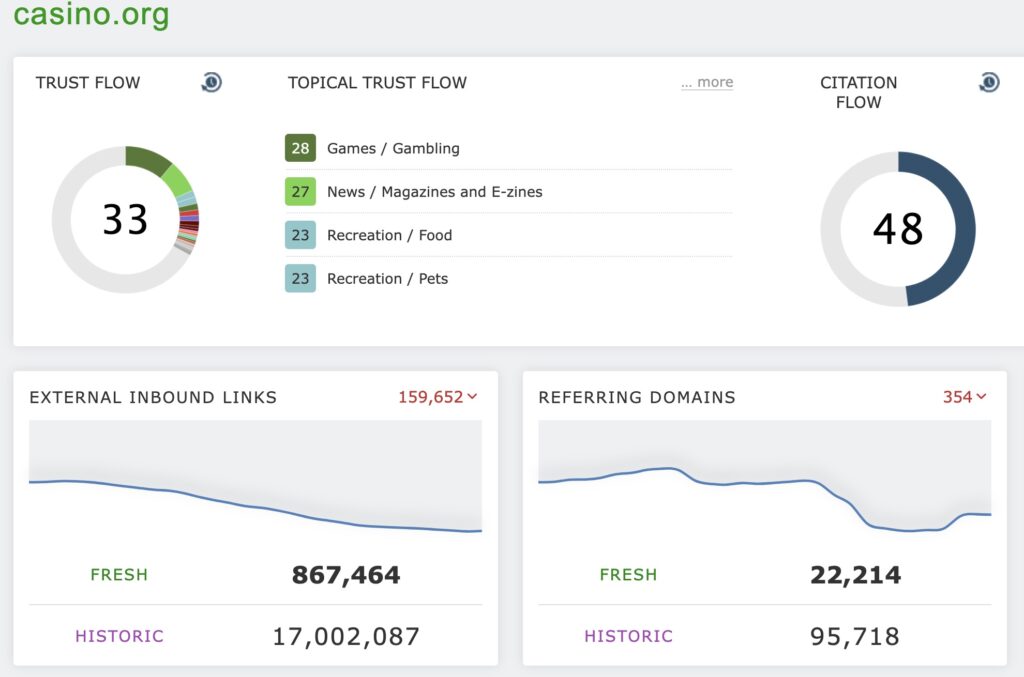
Example 1: link profile of casino.org
Example 2: link profile of Slotsia
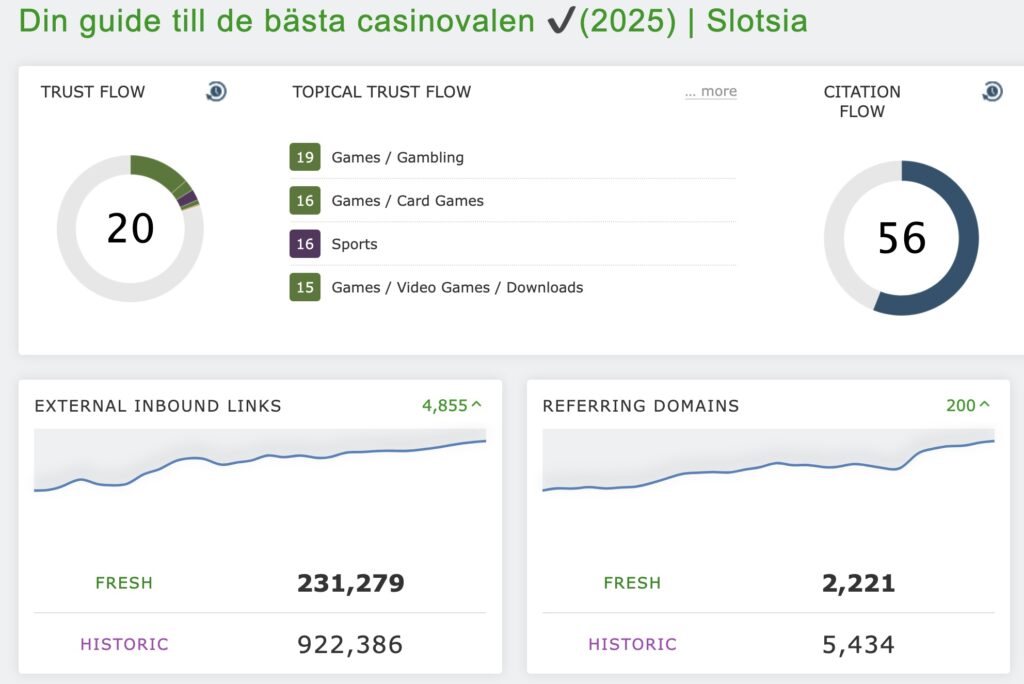
Both these sites got their share of this link spam – any at least somewhat organically visible site got it. But casino.org is a very old site with a strong link profile, whereas Slotsia’s link profile is much weaker. Casino.org’s link profile won’t be affected as much by the link spam as Slotsia – this is especially clear if we look at the top used anchor texts of the incoming links of both sites:
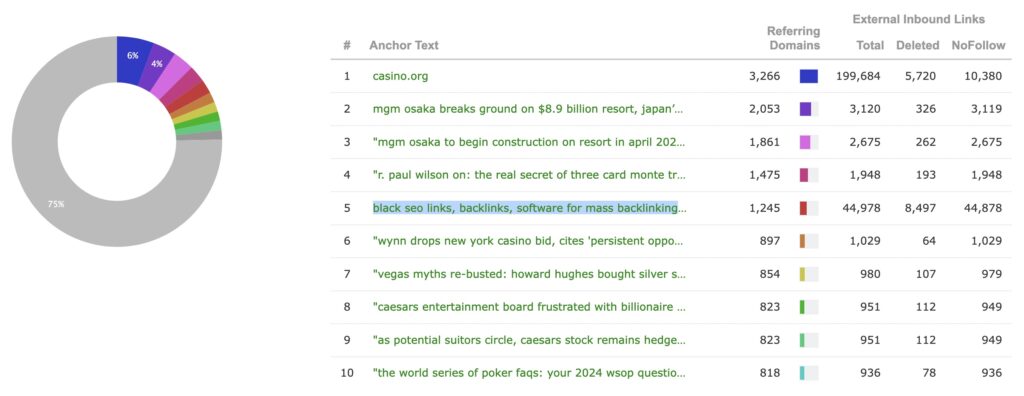
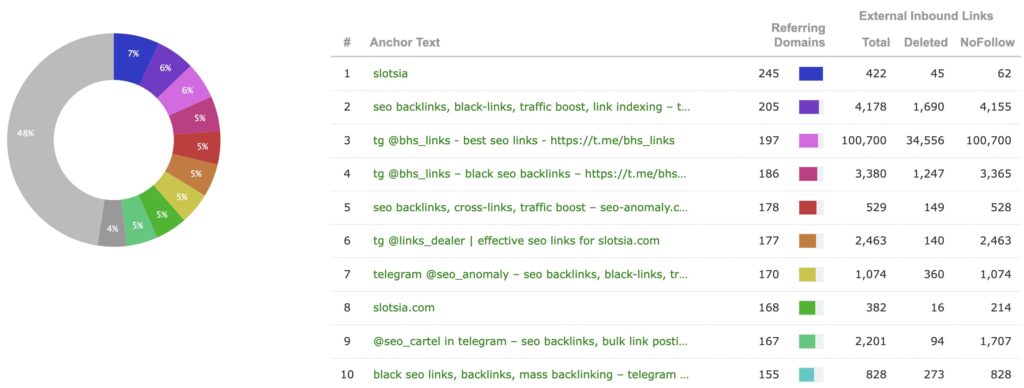
For casino.org, the most numerable anchor text of spammy links, while numerous enough to appear in the top 10 anchor texts list, is still only a small percentage of the entire link profile. While in the future it may be advisable to disavow the offending links, this is not the first priority as of now. For Slotsia however, the link spam-related anchor texts appear to almost completely override the “proper” link profile. Considering that, as well as the fact that Slotsia has apparently been negatively affected by spam updates in the past, the safest course of action in my opinion would be to disavow these “unwanted” links as they dilute the topical relevance of the site’s link profile.
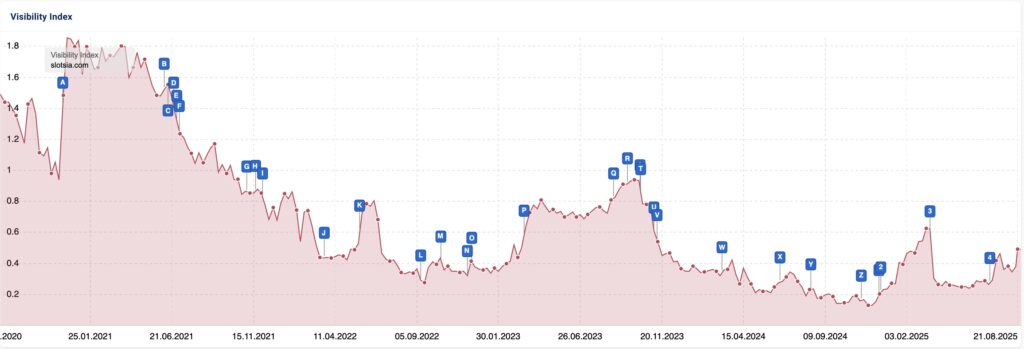
That said, the disavow tool should be used very carefully and only after careful manual analysis of the site’s link profile only by experienced SEOs who can understand what exactly they are looking at. Also, the disavow tool may be discontinued by Google in the future.
Generally, is negative SEO still a thing? Yes it is, but most of what people interpret as negative SEO is really something else, most likely somebody’s clueless idea of some kind.
How do you build topically relevant, natural looking links?
The best links you can acquire are those your competitors cannot easily copy. What cannot be easily copied?
1. Real-world relationships – you take part in some event, or interview somebody about an interesting (and relevant to you!) topic, and get a link back to your site.
2. Resource-intensive content – you do some research about something interesting and relevant and create content based on that research, your research results get quoted by everyone in the industry and even by mainstream media with links back to your site.
Can every site afford these or pull them off? – probably not, but it all depends on your creativity. After all, SEO is not just a mechanical process, it’s a space for ideas and innovation.
But let’s get back to our “best online casino bonus” SERP example.
Sponsored content in media publications
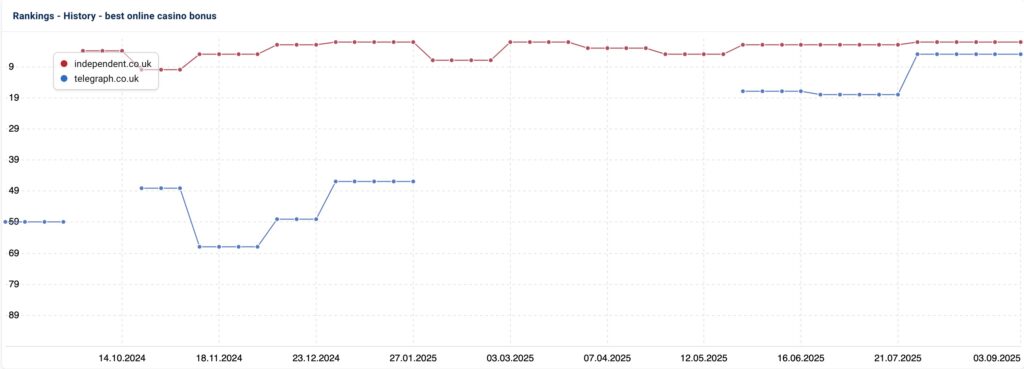
Even though we disregarded the newspaper sites in the top 10, let’s look at them again. As of now, we have two newspapers in the UK SERPs: The Independent and The Telegraph. In both cases, they have started publishing sponsored content a while ago and continue doing it. I wrote an article back in 2023 when mainstream media in the gambling SERPs was a much more widespead phenomenon. Since then, Google released updates which were supposed to deal with the issue, declared it was unacceptable to abuse the reputation of third party sites for ranking unrelated content, then settled on objecting just against the poorly curated third party content… As we can see, it’s not as bad as a couple of years ago, but sponsored content in gambling SERPs is still a thing.
However, you cannot expect to do it once and rank forever. The very nature of the newspapers precludes that the published content gets picked up, indexed and ranked fast, ranks well since newspapers are perceived as authoritative sources, but then disappears from the SERPs equally quickly. To stay ranking, you need to either keep publishing new content or keep updating what’s already published. The newspapers mentioned here also went to great lengths to show they are directly involved in creating that content.
Do aged domains work?
In short, yes of course they do. Longer answer: it’s not the actual age of a domain that matters but its history. A domain name may have been first registered in 1999 but only had a live site on it for the last 5 years – in this case, it doesn’t matter when it was first registered as it had no real history until recently. Can you repurpose unrelated aged domains? While this is something I see happening (and ranking) in many non-English language SERPs, in the markets Google pays more attention to (e.g. US and UK) this is rare and by repurposing an unrelated domain you are basically starting from scratch as its previous history no longer matters. With topically relevant domains, as long as you stick to the topic, you benefit from its history, especially if the domain had relevant rankings and still has relevant backlinks.
Can you rank AI generated content?
The big question about generated content is not whether it’s been generated but how it was generated. Some generated but curated by humans content with proper editorial oversight can and will perform better than poorly written content produced by humans. But with all the ease of content creation we now have as LLMs become more widespread (yes, large language models – I prefer to not call them AI as this is not real AI), we need to always ask ourselves about the purpose of content we are creating and publishing: what are we trying to achieve with that content? Are we adding any value or just rehashing what has already been published with slight variations by everyone and their dog? Will our visitors actually read this content or does it only exist to feed something to the search engines?
It is not true that all AI generated content will be deindexed or even never get indexed – after all, the biggest creator of generated content is Google itself with their AI overviews in so many SERPs. They are not doing the best job with it either – content used entirely out of context, sloppily put together, sometimes full of factual errors. But let’s admit it, assisted content creation is now a thing and it’s likely not going away. Understanding the limitations of LLMs and properly directing the process can be helpful and produce better results. You won’t get very far however without actual understanding of the topic you are producing the content about.
Can you get converting traffic from social media?
Yes you can, and in more ways than one.
First of all, do not assume that social media users (or specifically the users of a given social media site) will not convert when you offer them something gambling-related. For years, I have been driving perfectly converting traffic to an affiliate site of mine from Pinterest and even Tumblr. The bigger risk is getting your account banned on some of the social media sites more strict about gambling content. With the right approach and understanding your target audience on a specific social media site, converting traffic is very achievable.
Secondly, having a presence on social media can have additional benefits, such as those social media sites – along with your content – ranking for queries you might not even be able to rank for organically with your actual site. I could also talk about online reputation and brand awareness benefits of social media presence, but I suppose you get the idea already.
Are your ranking expectations realistic?
Do you expect to rank in the top 10 for “online casino” or some equally big impact query with a newly launched affiliate site with only a handful of links? That is probably not going to happen. However, in gambling SEO I would make a distinction between traditionally affiliate-dominated SERPs and operator-dominated SERPs. This has a lot to do with the user intent and how Google understands it. For example, a user searching for “online casino” likely expects to see the actual online casinos. On the other hand, does a user searching for “best online casino bonus” expect to see the bonus offers directly on the operator sites or information about these bonuses on affiliate sites reviewing them? While until pretty recently, those SERPs tended to be populated largely by affiliates, what we see today is a mix of both affiliates and operators. Why? Perhaps because Google’s understanding of user intent has shifted, or perhaps because too many affiliate sites are too unoriginal and just rehash the same things as hundreds of their competitors, or maybe even because operators have started paying more attention to their SEO, or even a combination of all these factors. That said, the SERPs in igaming keep changing all the time, so what’s true today might be completely wrong tomorrow. Keep an eye on the SERPs, that’s the only place where you will find the answers.
Want more content like this? Subscribe to my Patreon to get monthly industry reports, exclusive research and more.